

— Instrument Panel · 5 Vitals —
Know your numbers in 10 seconds.
Five precision calculators — BMI, TDEE, macros, body fat, and daily water — built for people who’d rather see a clear reading than scroll through another article.
BMI Calculator
READING 01BMI is a general screening measure, not a diagnosis. Muscle mass, frame size, and body composition change what’s “healthy” for you — a doctor or dietitian can give you the full picture.
TDEE Calculator
READING 02Estimated with the Mifflin–St Jeor equation, the standard used by dietitians. Treat this as a starting point and adjust based on real-world results over 2–3 weeks.
Macro Calculator
READING 03Grams are rounded estimates. Whole-food sources of each macro matter as much as the numbers — this is a target, not a rulebook.
Body Fat Calculator
READING 04Estimated using the U.S. Navy circumference method — accurate to roughly ±3–4%. For precise readings, ask about DEXA or calipers with a professional.
Water Intake Calculator
READING 05Each icon = one 8 oz glass. General hydration guidance — thirst, urine color, and how you feel are still your best day-to-day signals.
Want a 30-day plan built around these numbers?
Get the printable plan that turns today’s reading into a day-by-day routine — drop your email and we’ll send it over.
What Is TDEE and Why Does It Matter?
Understanding Total Daily Energy Expenditure
Total Daily Energy Expenditure — TDEE — is the complete number of calories your body burns in a 24-hour period. It accounts for everything: keeping your heart beating, digesting food, walking to your car, and every workout in between. Knowing your TDEE gives you a precise calorie target rather than a vague guess, making it the cornerstone of any serious nutrition plan.
The Science Behind Energy Balance
Energy balance is straightforward: consume fewer calories than your TDEE and you lose weight; consume more and you gain. The challenge is calculating TDEE accurately. PubMed studies on Mifflin-St Jeor accuracy vs. other formulas NIH NCCIH confirm that the right prediction equation makes a measurable difference in real-world outcomes. A reliable TDEE calculator removes the guesswork, giving you a data-driven foundation for fat loss, muscle gain, or maintenance.
How Is TDEE Calculated? Breaking Down the Formulas

The Mifflin-St Jeor Equation: Most Accurate for Most People
The Mifflin-St Jeor equation is widely considered the most reliable for estimating TDEE for the general population. It takes into account your age, sex, weight, and height to calculate your Basal Metabolic Rate (BMR), the calories your body burns at rest. Your TDEE is then derived by multiplying your BMR by an activity factor that reflects your exercise and daily movement levels. While generally accurate, it’s an estimation and doesn't account for individual differences in body composition.
Katch-McArdle Formula: When Body Composition Matters
For individuals with a keen interest in their body composition, the Katch-McArdle formula offers a more nuanced approach. This method calculates BMR based on Lean Body Mass (LBM) rather than total weight, making it potentially more accurate for athletes or those with significantly different muscle-to-fat ratios. To use Katch-McArdle effectively, you’ll need to know your LBM, which can be obtained through methods like bioelectrical impedance analysis or, for greater precision, a professional body composition analysis service or DEXA scan.
Harris-Benedict vs. Modern Approaches
The original Harris-Benedict equation, developed in the 1910s, is now largely outdated. While it was a groundbreaking calculation for its time, modern formulas like Mifflin-St Jeor and Katch-McArdle have been shown to be more accurate due to updated research and a better understanding of metabolic processes. NIH research on metabolic adaptation and TDEE changes Mayo Clinic further highlights the limitations of older formulas when applied to diverse populations.
TDEE vs. BMR: What's the Critical Difference?
While both BMR and TDEE relate to the calories your body burns, they measure different things. BMR, or Basal Metabolic Rate, represents the absolute minimum calories your body needs to perform essential life-sustaining functions at rest. Think of it as the energy required to keep your heart beating, lungs breathing, and brain functioning while you're completely inactive. TDEE, on the other hand, accounts for your BMR plus all the calories you burn through daily activities, exercise, and even the thermic effect of food (the energy used to digest and process food). Harvard Health on energy balance and weight management highlights that understanding this difference is crucial for effective weight management PubMed.
Basal Metabolic Rate Explained
Your BMR is influenced by factors like age, sex, muscle mass, and genetics. It's the baseline energy expenditure before any movement or activity is considered. A higher muscle mass generally leads to a higher BMR because muscle tissue burns more calories at rest than fat tissue.
Activity Multipliers and Real-World Impact
The critical difference between BMR and TDEE lies in the addition of your activity level. This is where the concept of activity multipliers comes into play. These multipliers are applied to your BMR to estimate the total calories burned throughout the day. Your lifestyle choices, from your sedentary desk job to your rigorous workout routine, significantly impact your TDEE. Even non-exercise activity thermogenesis (NEAT) – the calories burned from fidgeting, walking around, or doing household chores – contributes to your overall energy expenditure.
Real-World Examples: How TDEE Impacts Your Goals

Case Study: Weight Loss on a 500-Calorie Deficit
Sarah, aiming to lose 1 pound per week, used a tdee calculator to establish her daily calorie target. After inputting her stats and activity level, she found her TDEE was approximately 2200 calories. By consistently consuming 1700 calories daily (a 500-calorie deficit), she successfully lost weight at the predicted rate for several weeks. This demonstrates how a calculated deficit, based on TDEE, can lead to predictable fat loss.
Case Study: Muscle Gain with a Caloric Surplus
Mark wanted to build muscle. His tdee calculator indicated a TDEE of 2500 calories. To fuel muscle growth, he aimed for a 250-calorie surplus, eating around 2750 calories per day. Combined with consistent strength training, he noticed steady increases in muscle mass without excessive fat gain, showcasing how a caloric surplus supports hypertrophy.
The Plateau Problem: Why Progress Stalls
Eventually, both Sarah and Mark might hit a plateau. As weight is lost, TDEE decreases. If calorie intake remains constant, the deficit shrinks, slowing or stopping weight loss. Similarly, as muscle is gained, BMR and TDEE can increase, requiring adjustments to maintain a surplus for continued growth. Understanding this dynamic nature, as explained by Mayo Clinic resources on BMR and metabolism Harvard Health, is crucial for long-term success.
How Accurate Are TDEE Calculators Really?
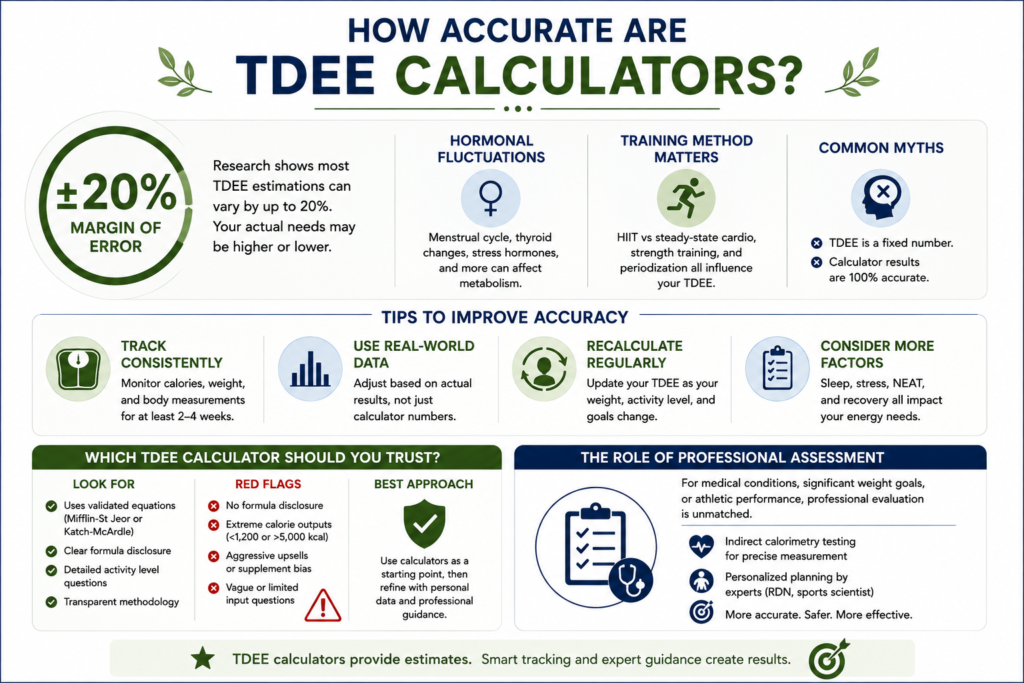
The ±20% Margin of Error: What Research Shows
While TDEE calculators offer a convenient starting point, it's crucial to understand their inherent limitations. Research suggests that most TDEE estimations can have a margin of error of up to 20% World Health Organization. This wide range means that your actual daily calorie needs could be significantly higher or lower than what a calculator suggests. Factors influencing this variability are complex and often overlooked in simple online tools.
Hormonal Fluctuations and Hidden Variables
Hormones play a surprisingly significant role in energy expenditure. For women, hormonal shifts during the menstrual cycle can subtly alter metabolic rate. Stress, too, can impact TDEE by influencing cortisol levels, which in turn affect appetite and fat storage. These "hidden variables" are difficult for standard calculators to account for.
Training Methodology Matters: Periodization and Cardio Type
The type and intensity of your training also influence your TDEE. High-intensity interval training (HIIT) burns more calories in a shorter period and has a greater "afterburn" effect than steady-state cardio. Furthermore, periodization – the planned cycling of training intensity and volume – means your calorie needs will fluctuate throughout the week or month, something a static TDEE calculation can't capture.
Common Myths About Calorie Accuracy
A prevalent myth is that a TDEE calculator provides a precise number. In reality, it's an educated guess. Another misconception is that calorie needs remain constant. As your body composition changes (e.g., gaining muscle or losing fat), your TDEE will also shift. Relying solely on a calculator without considering these dynamic factors can lead to frustration and stalled progress.
How to Use Your TDEE for Practical Results
Once you have your TDEE number, it’s time to put it to work. This figure serves as your baseline for managing your energy balance, but how you use it depends on your specific objectives.
Setting Your Caloric Target Based on Goals
If your goal is weight loss, you'll aim to consume fewer calories than your TDEE, creating a caloric deficit. For weight gain, you'll eat more than your TDEE to achieve a surplus. For weight maintenance, your target is to eat right around your calculated TDEE.
Tracking Progress and When to Recalculate
Consistent tracking is key. Use a reliable fitness tracking app or nutrition software to monitor your daily caloric intake and expenditure. This allows you to see if you're sticking to your target. If you're not seeing the expected changes after 2-4 weeks, or if your activity levels significantly change, it’s time to recalculate your TDEE.
Adjusting TDEE Based on Actual Results
Your initial TDEE calculation is an estimate. If you're consistently eating at your target and not experiencing the predicted weight change, your actual TDEE might be different. For instance, if you're trying to lose weight but aren't losing, your body might be burning fewer calories than predicted, meaning your true TDEE is lower. You may need to further reduce your intake or increase activity. Conversely, if you're gaining weight unexpectedly while trying to maintain, your TDEE might be higher than calculated, and you may need to increase your intake slightly.
Which TDEE Calculator Should You Trust?
Evaluating Calculator Reliability
The most trustworthy TDEE calculators use validated equations — Mifflin-St Jeor or Katch-McArdle — and clearly state which formula they apply. Look for tools that ask for detailed activity information rather than offering just three or four vague lifestyle categories. Transparency about methodology is the strongest signal of a reliable tool.
Red Flags in Online Tools
- No formula disclosure — if the method is hidden, the result is unverifiable
- Extreme calorie outputs — results below 1,200 or above 5,000 for average adults warrant skepticism
- Aggressive upsells — calculators designed primarily to sell supplements often inflate or distort numbers
The Role of Professional Assessment
For medical conditions, significant weight goals, or athletic performance, no online calculator replaces professional evaluation. A registered dietitian or sports scientist can combine indirect calorimetry testing Mayo Clinic Yoga with personal context — something no algorithm can replicate. Use calculators as a starting framework, but treat professional guidance as the gold standard when precision genuinely matters.
About the Author

Pratham Bavkar — Wellness Researcher · Founder, Yoga Therapy Guide
Pratham Bavkar is the founder of Yoga Therapy Guide and a wellness researcher focused on yoga therapy, mobility, and posture health. He creates evidence-based, beginner-friendly guides on yoga poses, stretching routines, and natural wellness practices to help readers improve daily health naturally.