
Understanding the Nervous System and Stress Response
Your body is constantly making decisions you’re not aware of — scanning for threat, calibrating safety, and shifting between states of activation and rest. Understanding this process is the foundation of somatic yoga exercises for nervous system regulation therapy, and it explains why so many conventional stress-relief strategies simply don’t reach deep enough.
The Autonomic Nervous System: Sympathetic vs. Parasympathetic
The autonomic nervous system (ANS) operates below conscious awareness, governing heart rate, digestion, and breath. Its two primary branches work in dynamic balance: the sympathetic branch mobilizes energy for action — the classic fight-or-flight response — while the parasympathetic branch governs rest, digestion, and recovery. Stephen Porges’ Polyvagal Theory Physiopedia expanded this model by identifying a third state: the dorsal vagal freeze response, a shutdown state triggered when the nervous system perceives threat as inescapable. This three-part framework is essential for understanding why some people feel anxious and others feel numb — and why both need targeted somatic approaches.
What Happens During Dysregulation
When the nervous system becomes dysregulated, it gets stuck — looping in sympathetic overdrive (anxiety, hypervigilance, insomnia) or collapsing into dorsal vagal shutdown (dissociation, fatigue, emotional numbness). The body loses its natural capacity to return to baseline, a process called neuroception failure. Chronic stress, trauma, and even prolonged sedentary behavior can all erode this self-regulating ability over time.
Why Traditional Stress Relief Falls Short
Breathing exercises, positive thinking, and even bedtime yoga with Adriene can help — but for deeply dysregulated nervous systems, top-down cognitive approaches often aren’t enough. The body holds stress in tissue, posture, and movement patterns that the thinking mind simply cannot access. Somatic yoga works bottom-up, using sensation, slow movement, and interoceptive awareness to directly communicate safety to the nervous system — bypassing the analytical brain entirely.
What is Somatic Yoga? The Mind-Body Bridge
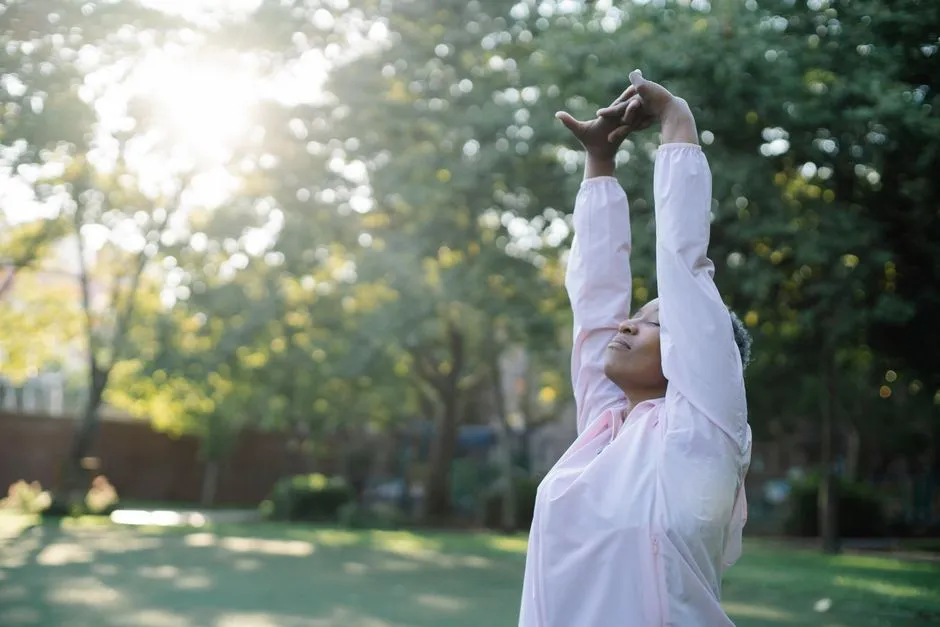
Somatic yoga is a therapeutic modality that treats movement as a conversation between the body and the nervous system — not simply a physical workout. The word somatic derives from the Greek soma, meaning “living body,” and this practice centers on cultivating conscious awareness of internal physical sensations to shift your physiological state. NIH NCCIH studies on yoga and nervous system regulation Verywell Health support the premise that intentional, body-centered movement can meaningfully influence autonomic function.
Somatic Awareness and Interoception
Interoception — your ability to sense internal bodily signals like heartbeat, breath, and muscular tension — is the foundation of somatic yoga. By deliberately attending to these signals, practitioners develop a real-time feedback loop that allows the nervous system to recognize safety and begin downregulating stress responses.
How Somatic Yoga Differs from Traditional Yoga
Where traditional yoga often emphasizes alignment, posture aesthetics, or sequencing, somatic yoga prioritizes felt experience over form. Movements are slower, exploratory, and frequently micro-scaled. For a broader comparison of movement modalities, see our guide on Yoga vs. Pilates: Complete Comparison Guide for Your Fitness Goals.
The Role of Proprioception in Nervous System Regulation
Proprioception — your body’s sense of position in space — communicates directly with brain regions governing threat detection. Slow, intentional somatic movements recalibrate these signals, helping interrupt chronic fight, flight, or freeze patterns at a neurological level.
How Somatic Yoga Regulates the Nervous System: The Mechanism
Vagal Tone and Polyvagal Theory
Psychiatrist Stephen Porges’ polyvagal theory proposes that the vagus nerve acts as a biological “safety detector,” continuously scanning the environment for cues of threat or safety. When vagal tone is high, the nervous system can flexibly shift between states — remaining calm under mild stress and recovering quickly afterward. Somatic yoga exercises for nervous system regulation therapy work directly on this pathway: slow, intentional movements paired with deliberate breath signal the vagus nerve that the body is safe, helping interrupt entrenched fight, flight, or freeze patterns. Mayo Clinic guidance on somatic therapies and trauma recovery NIH NCCIH supports the use of body-based practices to complement traditional trauma treatment.
Movement as Nervous System Signaling
Every movement sends proprioceptive data to the brain. In somatic yoga, movements are performed slowly and with conscious attention, which amplifies this sensory feedback loop. Rather than pushing through a pose, practitioners are guided to notice subtle internal sensations — tension releasing in the jaw, warmth spreading through the chest — generating interoceptive awareness that helps the brain update its threat assessment. This is meaningfully different from faster-paced styles; for a useful comparison, see our guide on Yoga vs. Pilates: Complete Comparison Guide for Your Fitness Goals.
The Role of Breath and Embodied Awareness
Extended exhalations directly stimulate the parasympathetic branch of the autonomic nervous system by activating the vagal brake. Somatic yoga pairs this with embodied awareness cues — gentle prompts to notice sensation without judgment — reinforcing the brain’s sense of present-moment safety and gradually building resilience across the entire nervous system.
Somatic Yoga Exercises for Specific Dysregulation States
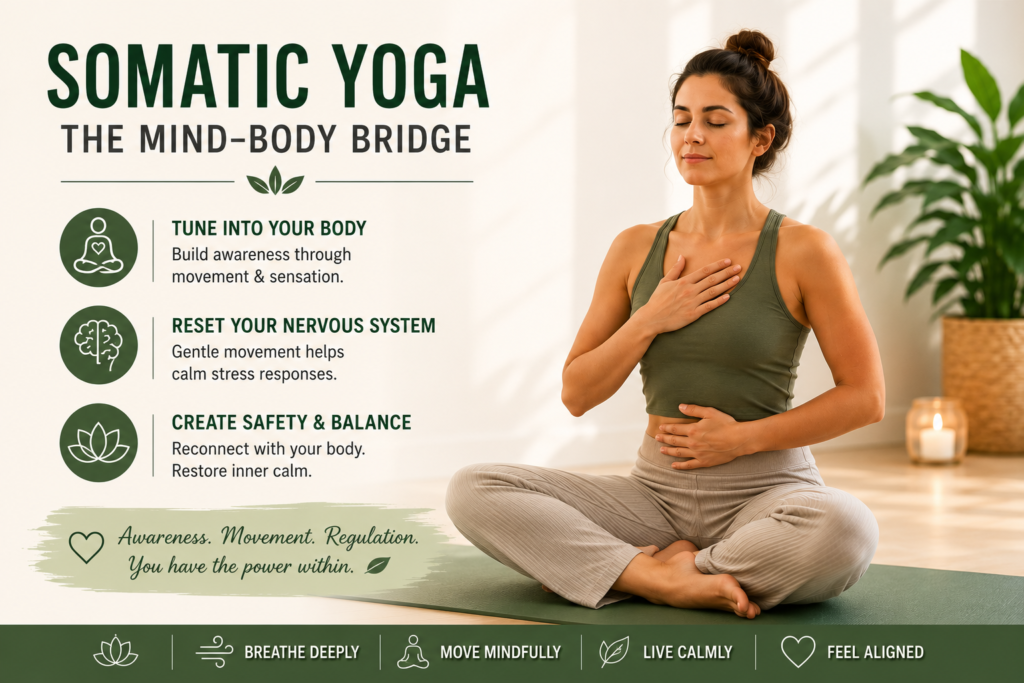
Somatic Yoga for Fight/Flight Response: Grounding and Release Practices
When the sympathetic nervous system is dominant, the body holds excess activation as muscle tension, rapid breathing, and a sense of urgency. These practices redirect that energy downward and outward.
- Heel Drop Shaking (2–3 minutes): Stand with feet hip-width apart. Rise onto your toes, then let your heels drop firmly to the floor. Allow the vibration to travel up through your legs. Notice where you feel the reverberation in your torso. This discharges stored adrenaline through rhythmic, neurologically familiar movement.
- Extended Exhale Warrior II: Hold Warrior II and lengthen your exhale to twice your inhale count. Feel your back foot pressing into the earth. Scan for jaw or shoulder bracing and consciously soften those areas between each breath cycle.
- Bound Angle Forward Fold: Sit with soles together, hinge forward slowly, and rest your forehead on stacked fists. Stay 90 seconds. Track whether your heart rate noticeably slows — that shift signals a parasympathetic response beginning.
Somatic Yoga for Freeze Response: Gentle Activation and Reconnection
Freeze states involve dorsal vagal shutdown — low energy, numbness, and disconnection. Forcing intensity here can deepen withdrawal. Instead, use micro-movements that gently restore felt-sense awareness. Verywell Health articles on vagal tone and parasympathetic activation Mayo Clinic highlight how gradual, bottom-up stimulation is essential for safely exiting immobilization states.
- Finger and Toe Awakening: Lying supine, slowly spread and curl each finger and toe individually. Name the sensations aloud or internally — warmth, tingling, pressure. This reestablishes peripheral body awareness.
- Supported Bridge with Humming: Place a block under your sacrum in supported bridge. Inhale, then hum on the exhale for its full length. The vibration directly stimulates the vagus nerve, nudging the system toward social engagement.
- Gentle Spinal Rolling: From seated, round your spine slowly vertebra by vertebra, then uncurl just as slowly. Pause mid-movement and ask: What do I notice right now? Interoceptive check-ins like this rebuild the internal signaling that freeze disrupts.
Somatic Yoga for Rest-Digest Maintenance: Deepening Parasympathetic Tone
For those whose nervous systems are regulated but prone to tipping back into dysregulation, a consistent maintenance practice builds resilience over time. Think of this as toning the vagal brake — the capacity to return to calm quickly after stress. For foundational pose options that complement this approach, see our guide on 10 Best Yoga Exercises for Every Goal: A Complete Guide with Modifications.
-
- Legs-Up-the-Wall (Viparita Karani, 5–10 minutes): This gentle inversion shifts blood flow, reduces cortisol, and invites a quiet body scan from feet to pelvis to chest.
Key Somatic Yoga Poses and Their Nervous System Effects
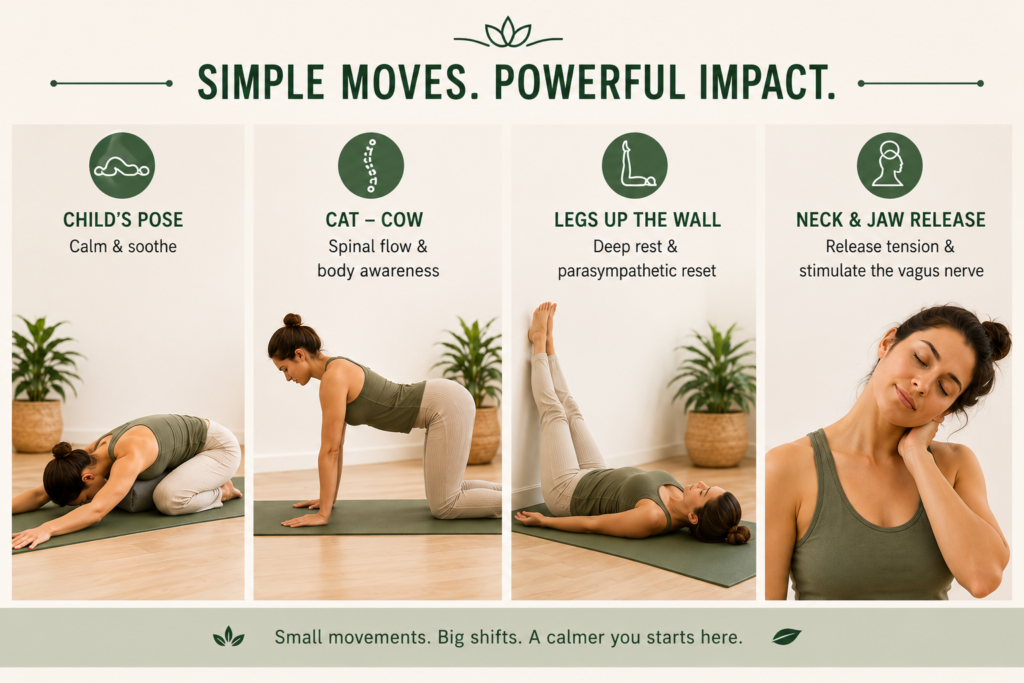
These four foundational movements form the backbone of somatic yoga exercises for nervous system regulation therapy, each targeting distinct physiological pathways to shift the body out of survival states.
Supported Child’s Pose (Balasana) – Vagal Activation
Gentle compression of the abdomen in Child’s Pose stimulates baroreceptors and activates the ventral vagal pathway, signaling safety to the nervous system. For trauma survivors, placing a bolster or folded blanket beneath the torso removes the vulnerability of full forward folding. A quality yoga bolster or meditation cushion enhances proprioceptive feedback and comfort, making sustained holds more accessible for those with chronic pain.
Slow Cat-Cow (Marjaryasana-Bitilasana) – Spinal Awareness and Flow
Rhythmic spinal flexion and extension cultivates interoceptive awareness — the felt sense of internal body states. Physiopedia resources on proprioception and interoception PubMed highlight how spinal movement activates mechanoreceptors that feed directly into body-mapping regions of the brain. Moving at roughly one breath per cycle keeps the nervous system in a regulated, exploratory state rather than triggering arousal. For hypermobile individuals, limiting range of motion protects joints while preserving the neurological benefit. See our guide on 10 Best Yoga Exercises for Every Goal: A Complete Guide with Modifications for additional movement modifications.
Legs-Up-the-Wall (Viparita Karani) – Parasympathetic Reset
Inverting the legs reduces venous return load on the heart, prompting a baroreceptor-mediated drop in sympathetic tone. This posture is particularly effective for freeze-state dysregulation. Supporting the sacrum with a folded blanket or cushion distributes weight evenly, making the pose sustainable for those with lower back sensitivity or chronic fatigue.
Gentle Neck Rolls and Jaw Release – Vagus Nerve Stimulation
The vagus nerve travels through the neck alongside the carotid artery, making slow, deliberate neck movement a direct route to vagal stimulation. Pairing neck rolls with conscious jaw unclenching — allowing the molars to separate and the tongue to rest softly — releases tension held in the trigeminal nerve network, a key contributor to stress-driven facial bracing. For trauma survivors, keeping movements small and self-directed preserves a sense of agency throughout the practice.
Somatic Yoga vs. Other Nervous System Therapies
Somatic yoga exercises for nervous system regulation therapy occupy a distinct niche among evidence-based approaches to trauma and stress recovery. Understanding how they compare to other modalities helps both therapists and individuals make informed choices about their healing path.
Somatic Yoga vs. EMDR: Similarities and Unique Advantages
Both somatic yoga and Eye Movement Desensitization and Reprocessing (EMDR) work with the body’s stored trauma responses rather than relying solely on cognitive processing. However, EMDR typically requires a trained clinician and structured sessions. Somatic yoga offers something EMDR cannot: a self-directed, daily practice that builds nervous system resilience over time. Peer-reviewed studies on somatic experiencing and nervous system healing Harvard Health suggest that body-based interventions create lasting neurological change, and somatic yoga’s accessibility means that regulation tools are always within reach — no appointment necessary.
Somatic Yoga vs. Trauma-Releasing Exercises (TRE): Complementary Approaches
TRE uses specific postures to trigger the body’s natural tremoring mechanism, discharging stored tension. Somatic yoga shares this emphasis on bottom-up healing but integrates breath awareness, intentional movement, and mindful attention simultaneously. Rather than competing, the two approaches work beautifully together — TRE can release deep muscular holding while somatic yoga builds the ongoing capacity to stay present within sensation.
Integrating Somatic Yoga with Mindfulness and Breathwork
Mindfulness and breathwork are powerful standalone practices, but somatic yoga 10 Best Yoga Exercises for Every Goal: A Complete Guide with Modifications provides the physical framework that makes regulation embodied rather than purely cognitive. When breathwork is anchored inside a somatic movement sequence, the nervous system receives layered, reinforcing signals of safety — making the combined practice more effective than any single modality alone.
Building a Personal Somatic Yoga Practice for Long-Term Resilience
Building a Personal Somatic Yoga Practice for Long-Term Resilience
Consistency is key for somatic yoga exercises for nervous system regulation therapy. Aim to start small with a 10-minute daily routine. Many find noticeable shifts within 2–4 weeks. To support your journey, consider downloading our free (a 1-page cheat sheet with 5 key poses, breathing cues, and a 10-minute routine). Track your nervous system changes over time by noting your emotional state, physical sensations, and stress levels before and after practice.
As you build capacity, gradually scale your practice. This might involve longer sessions or incorporating more complex movements. Remember, the goal is sustainable resilience, not immediate perfection. For inspiration on foundational poses, you might find our guide on 10 Best Yoga Exercises for Every Goal: A Complete Guide with Modifications helpful.
Frequently Asked Questions About Somatic Yoga for Nervous System Regulation
Can somatic yoga help retrain a nervous system that feels permanently stuck?
Yes. Thanks to neuroplasticity, the nervous system retains the capacity to form new regulatory pathways throughout life. Research on trauma-sensitive movement Physiopedia confirms that consistent somatic practice gradually shifts baseline threat responses — even in people who have felt dysregulated for years. Progress is incremental, but it is real.
What’s the difference between somatic yoga and regular yoga?
Conventional yoga often emphasizes alignment, strength, or flexibility as external goals. Somatic yoga yoga prioritizes internal sensation awareness over shape or performance. Movements are slower, smaller, and chosen specifically to discharge stored stress — not to achieve a pose. For a broader comparison of yoga styles and goals, see our guide on 10 Best Yoga Exercises for Every Goal: A Complete Guide with Modifications.
Are there contraindications or populations who should modify somatic yoga?
Somatic yoga is broadly accessible, but individuals with acute trauma, dissociative disorders, or severe PTSD should work with a qualified therapist before practicing independently. Ground-level poses may need modification for those with joint conditions or limited mobility.
How do I know if my nervous system is actually regulating?
Look for subtle but consistent signs: slower, deeper breathing during practice, reduced muscle bracing, a sense of warmth or heaviness in the limbs, and improved sleep or emotional resilience between sessions. These signals indicate a genuine shift from sympathetic dominance toward parasympathetic recovery.
About the Author

Pratham Bavkar — Wellness Researcher · Founder, Yoga Therapy Guide
Pratham Bavkar is the founder of Yoga Therapy Guide and a wellness researcher focused on yoga therapy, mobility, and posture health. He creates evidence-based, beginner-friendly guides on yoga poses, stretching routines, and natural wellness practices to help readers improve daily health naturally.