
Introduction to Yoga for Menopause
Hot flashes at 2 a.m. Brain fog that derails your workday. Mood swings that feel completely out of character. If you’re navigating menopause, you already know it’s far more than a hormonal shift — it’s a whole-body upheaval that can quietly erode your quality of life. The good news? Yoga for menopause is emerging as one of the most evidence-backed, accessible tools available to women at this stage of life.
Why Menopause Demands a Holistic Approach
Menopause affects sleep, cardiovascular health, mood, bone density, and metabolism simultaneously. No single medication addresses all of these dimensions. That’s precisely why holistic practices — ones that calm the nervous system, strengthen the body, and steady the mind — are gaining serious clinical attention. For a broader look at how movement-based therapies support complex health conditions, see our guide on how yoga helps manage chronic diseases.
How Yoga Addresses Menopause Symptoms
NIH NCCIH studies on yoga efficacy for menopause symptoms NIH NCCIH demonstrate measurable reductions in hot flash frequency, anxiety, and sleep disturbance among regular practitioners. Yoga works through multiple pathways — regulating cortisol, supporting hormonal balance, and activating the parasympathetic nervous system — making it uniquely suited to the layered challenges menopause presents.
Understanding Menopause Phases and Yoga’s Role

Menopause isn’t a single moment — it’s a multi-year hormonal transition that unfolds in distinct phases, each presenting different challenges and opportunities for yoga practice. Understanding where you are in this timeline helps you tailor your practice for maximum benefit rather than applying a one-size-fits-all approach. Mayo Clinic guidelines on menopause management and complementary therapies Mayo Clinic recognize that individualized, phase-aware strategies produce better outcomes than generic interventions.
Perimenopause: Early Intervention with Yoga
During perimenopause, fluctuating estrogen and progesterone levels can trigger irregular cycles, mood swings, and disrupted sleep — sometimes years before the final period. A consistent yoga practice introduced at this stage may help regulate the stress-response system, potentially softening hormonal volatility before symptoms intensify. Restorative poses, breathwork, and gentle flows are particularly valuable here. Since hormonal imbalances during perimenopause share some overlap with other endocrine conditions, our guide on offers complementary insights worth exploring.
Menopause: Symptom Management Through Practice
At the point of menopause — defined as 12 consecutive months without a period — estrogen levels drop sharply. Hot flashes, night sweats, anxiety, and joint discomfort become most acute. Cooling pranayama techniques like Sitali breath, alongside slow, mindful sequences, can help modulate the autonomic nervous system and reduce the frequency and intensity of vasomotor symptoms. Consistency matters more than intensity at this stage.
Postmenopause: Building Strength and Bone Density
Once through menopause, the focus shifts toward long-term health protection. Declining estrogen accelerates bone loss and increases cardiovascular risk. Weight-bearing yoga poses — standing balances, lunges, and gentle backbends — directly stimulate bone remodeling, while strength-building sequences support muscle mass preservation. A well-structured postmenopause practice prioritizes stability, strength, and longevity over flexibility alone.
Best Yoga Styles for Menopause Relief
Not all yoga styles deliver equal benefits during menopause. Matching the right practice to your current symptoms — whether hot flashes, anxiety, joint stiffness, or disrupted sleep — can make a meaningful difference in how effectively yoga supports your transition.
Hatha Yoga: Foundational Stability
Hatha yoga’s slower pace and emphasis on held postures make it an excellent entry point for menopausal women. Controlled breathing paired with deliberate movement activates the parasympathetic nervous system, helping to reduce cortisol spikes that worsen hormonal fluctuations. Harvard Health research on hormonal changes and nervous system regulation PubMed highlights how this kind of mindful movement can support endocrine balance during perimenopause.
Restorative Yoga: Nervous System Regulation
Restorative yoga uses props to hold passive poses for extended periods, signaling deep safety to the nervous system. This directly counters the sympathetic “fight-or-flight” dominance common during menopause, which amplifies hot flashes and sleep disruption. For women also managing stress-related conditions, our guide on best yoga poses for stress relief offers complementary techniques.
Yin Yoga: Deep Tissue Release
Yin yoga targets connective tissue and fascia through long, floor-based holds. During menopause, declining estrogen reduces joint lubrication, making this gentle approach particularly valuable for maintaining hip and spine mobility without strain.
Why Avoid Hot Yoga During Menopause
Hot yoga practiced in rooms heated above 95°F raises core body temperature — the very trigger mechanism behind vasomotor hot flashes. For women already experiencing thermoregulatory instability, this environment can intensify rather than relieve symptoms. A cool, well-ventilated practice space is strongly recommended instead.
Specific Yoga Poses for Menopause Symptoms
Poses for Hot Flashes and Night Sweats
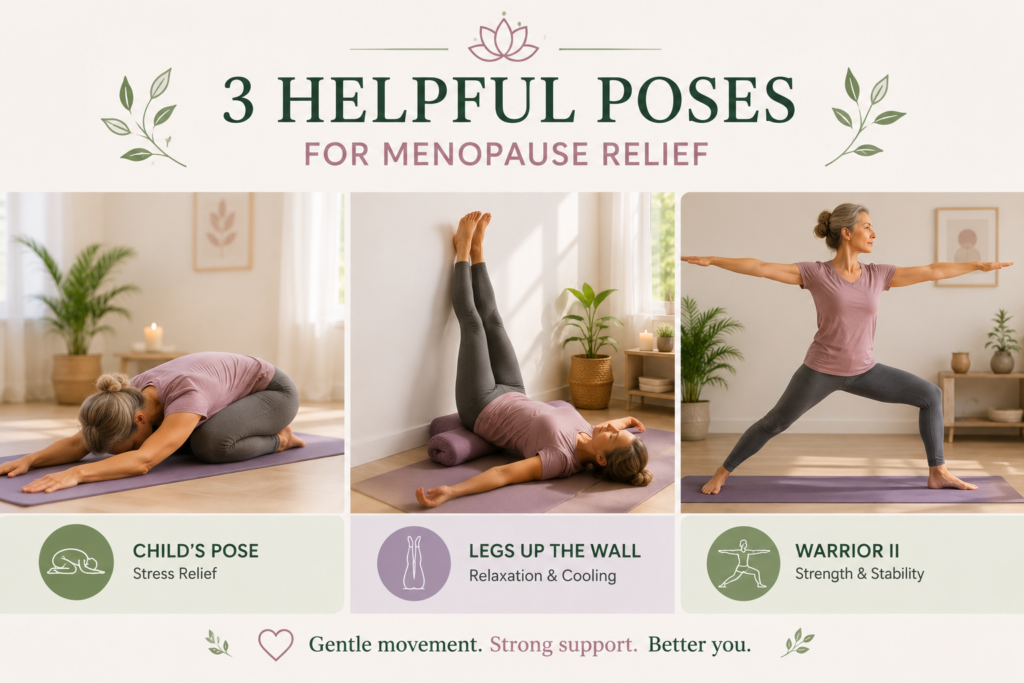
Cooling, forward-folding postures help activate the parasympathetic nervous system, which can reduce the frequency and intensity of vasomotor symptoms. Sitali Pranayama (cooling breath) paired with Supported Forward Fold is particularly effective — resting your forehead on a bolster or stacked blocks signals the nervous system to downregulate. PubMed peer-reviewed studies on parasympathetic activation via yoga Harvard Health support the link between restorative forward bends and reduced hot flash frequency. Legs-Up-the-Wall (Viparita Karani) is another excellent option: elevating the legs encourages venous return and gently cools the body without exertion.
Poses for Mood Swings and Anxiety
Estrogen fluctuations directly affect serotonin pathways, making mood regulation one of menopause’s most challenging symptoms. Gentle backbends like Supported Fish Pose and Reclined Bound Angle (Supta Baddha Konasana) open the chest and stimulate the vagus nerve, promoting emotional steadiness. A quality yoga bolster/props set makes these restorative shapes genuinely accessible — without adequate support, most people cannot fully release tension and receive the pose’s benefits. For a broader anxiety-reduction framework, see our guide on Best Yoga Poses for Stress Relief: Science-Backed Sequences for Immediate Calm.
Gentle Poses for Joint Pain and Stiffness
Declining estrogen reduces synovial fluid production, increasing joint discomfort. Cat-Cow, Seated Spinal Twist, and Reclined Pigeon lubricate the hips and spine without loading vulnerable joints. For women with reduced bone density, avoid deep spinal flexion; instead, prioritize Warrior II and Tree Pose, which build weight-bearing strength safely.
Poses for Sleep Disruption
A consistent pre-sleep sequence of Child’s Pose, Supine Twist, and Savasana with bolster support lowers cortisol and prepares the body for deeper rest. Holding each pose for three to five minutes in a Yin style encourages genuine nervous system recovery — the kind of slow, intentional practice that medication alone cannot replicate.
The Science Behind Yoga and Menopause Symptom Management
Understanding why yoga works for menopause requires looking beyond anecdote and into physiology. Research consistently shows that a regular yoga practice influences several biological systems disrupted during the menopausal transition — from the autonomic nervous system to bone metabolism.
How Yoga Regulates the Nervous System
Menopause frequently tips the autonomic nervous system toward sympathetic dominance — the “fight-or-flight” state — which amplifies hot flashes, disrupts sleep, and heightens anxiety. Slow, controlled breathing and mindful movement activate the parasympathetic branch, lowering heart rate and cortisol output. For women who want to extend this regulation beyond the mat, a guided meditation and mindfulness app can reinforce daily nervous system recovery between practice sessions.
Yoga’s Impact on Hormone Fluctuations
The hypothalamic-pituitary-adrenal (HPA) axis, which governs stress hormone release, becomes dysregulated as estrogen declines. Studies reviewed by the NIH National Center for Complementary and Integrative Health Mayo Clinic Yoga suggest mind-body practices like yoga help modulate HPA axis reactivity, potentially reducing the severity of vasomotor symptoms such as hot flashes and night sweats. For a broader look at how yoga supports hormonal conditions, see our guide on.
Stress Reduction and Mood Stabilization
Declining estrogen directly affects serotonin and GABA pathways, making mood instability a genuine neurochemical event — not simply emotional sensitivity. Yoga increases GABA levels in the brain, which supports calmer mood states and improved sleep quality, offering measurable psychological benefits that extend well beyond general stress relief.
Building Bone Density Through Weight-Bearing Poses
Postmenopausal bone loss is one of the most clinically significant risks women face. Cleveland Clinic data on bone density and weight-bearing exercise Cleveland Clinic confirms that load-bearing activity stimulates osteoblast activity, slowing the rate of bone loss. Standing yoga poses — Warrior sequences, Triangle, and Tree pose — apply precisely this kind of controlled mechanical stress to the skeleton, making yoga a practical, low-impact strategy for long-term skeletal health.
Creating Your Menopause Yoga Practice

Optimal Frequency and Duration
Research suggests that three to five sessions per week, each lasting 30–60 minutes, offers meaningful symptom relief for menopausal women NIH NCCIH. Even shorter 20-minute sessions practiced consistently outperform occasional longer ones. Prioritize regularity over intensity — your nervous system responds best to predictable, gentle stimulation.
Building a Beginner-Friendly Routine
Start with two or three sessions weekly and build gradually. A simple structure works well: 5 minutes of breathwork, 20 minutes of poses, and 5 minutes of Savasana. For detailed guidance on establishing a home practice from scratch, see our article on how to do yoga at home for beginners.
Modifications for Common Physical Changes
Joint sensitivity, reduced bone density, and balance changes are common during menopause. Use blocks, bolsters, and blankets freely. For weight-bearing poses that support bone health, a reliable non-slip yoga mat is genuinely important — it reduces fall risk and cushions pressure-sensitive joints.
Tracking Progress with a Symptom Tracker
Log hot flash frequency, sleep quality, and mood daily alongside your practice notes. Patterns typically emerge within four to eight weeks, helping you identify which poses and styles deliver the most personal benefit. A simple notebook works — consistency of recording matters more than the tool.
Common Myths About Yoga and Menopause
Myth: Yoga Alone Cures Menopause
Yoga is a powerful supportive tool, not a standalone treatment. It can meaningfully reduce hot flashes, improve sleep, and ease anxiety, but it works best alongside medical guidance. Always discuss symptoms with your healthcare provider before relying solely on yoga.
Myth: You Need to Be Flexible to Start
Flexibility is a result of practice, not a prerequisite. Beginners can start with gentle, chair-supported poses immediately. If you’re new to movement, our guide on how to do yoga at home for beginners walks you through safe first steps.
Myth: All Yoga Styles Are Safe During Menopause
Hot yoga and intense power classes can actually trigger or worsen hot flashes and elevate blood pressure. Restorative, yin, and gentle hatha styles are generally the safest starting points. Listen to your body, and when in doubt, choose cooling and calming over vigorous.
About the Author

Pratham Bavkar — Wellness Researcher · Founder, Yoga Therapy Guide
Pratham Bavkar is the founder of Yoga Therapy Guide and a wellness researcher focused on yoga therapy, mobility, and posture health. He creates evidence-based, beginner-friendly guides on yoga poses, stretching routines, and natural wellness practices to help readers improve daily health naturally.